The three survivors’ fugitive status
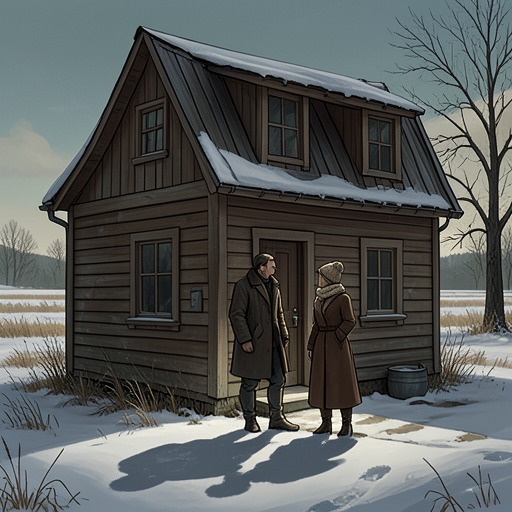
American WomanThe three survivors’ fugitive status is the unstable condition left behind when a televised catastrophe appears to have erased the revolutionary cadre. Juan, Yvonne, and Pauline have escaped the Los Angeles siege, but their survival is initially concealed by the belief that all twelve members died. Hiding in Jenny’s house, they are at once the targets of an intensifying manhunt and participants in a struggle over what the public will believe happened. Their broadcasts make survival into a political message; approaching cars and inadequate defenses make clear how vulnerable that message’s speakers remain.
Escape and the public miscount
The survivors’ disappearance follows the cadre’s spectacular collapse in Los Angeles. During a memorial rally, Sandy speaks for the dead revolutionaries, whose kidnapping, bank robbery, and conversion of Pauline had already made them notorious. The fire after the hours-long shootout appears to settle their fate: remains are recovered from the ashes, and the public treats the dead as a completed story. Yet three members whom police believe were killed are still alive. Their survival overturns the official count and turns the apparent aftermath into a new phase of the crisis.
By the time Jenny brings newspapers and news magazines to the survivors’ hiding place, the first wave of coverage has passed. The covers had shown the fire and described the group as surrounded; inside were photographs of the twelve comrades from their former lives. The reports now identify nine bodies, while Juan, Yvonne, and Pauline are confirmed missing. The FBI is searching in Los Angeles and south toward Mexico. Sightings have been reported across the West Coast, from Canada to Tijuana, but not in the East. The mismatch between a nationwide manhunt and the survivors’ continued concealment gives their refuge a temporary advantage, not security.
Broadcasting survival
The survivors do not remain silent. In a broadcast that interrupts regular programming, Yvonne delivers a detailed account of a police action, while Juan follows with a sweeping political interpretation. His speech turns the presumed destruction of the cadre into a claim that its opponents failed: he presents the survivors as having escaped the fire, lived outdoors, and moved among ordinary people without being recognized. He also describes them as sharing the conditions of the poor, including eating discarded food. These assertions are part of the broadcast’s argument, not an independent report of events, but the transmission gives the fugitives a way to address a public that believes them dead.
The broadcast is heard inside the hideout, where Yvonne watches Juan for a response and Pauline listens without moving. The news coverage that follows renews attention to the survivors and directs the investigation toward Boulder. For Jenny, the update brings immediate worry about Dana, while the others are absorbed in their own reactions. The radio thus serves two purposes at once: it carries the fugitives’ political voice beyond the house, and it brings the consequences of public attention back into their confined domestic space.
Pauline’s recorded declaration also becomes part of the public contest over her status. In a broadcast dated April 3, 1974, she announces that she will remain with the comrades rather than return to her family, framing them as her new family and their cause as the only just struggle. The news commentary afterward treats the declaration as evidence of coercion and asks listeners to imagine what she endured. When Jenny returns to Dolly’s house, Dolly calls Pauline brainwashed; Jenny challenges the certainty of that explanation. The competing accounts—willing commitment or captive’s testimony—make Pauline’s voice both a political instrument and the focus of a dispute that the fugitives cannot control.
A refuge under pressure
The hiding place offers concealment but little protection. One night, Pauline warns that someone is coming. Jenny and the others move through the dark as a car approaches without visible lights; Juan rushes outside and returns with a rake, saying they have no means of defense. The scene exposes the distance between the cadre’s rhetoric of defiance and its practical vulnerability. Their survival depends not on an arsenal but on avoiding discovery.
Frazer later arrives after dark, also driving without lights. He takes Jenny aside and rebukes her for allowing the group’s manifesto to reach the radio; his own precautions, he explains, are meant to avoid detection by unknown pursuers. His arrival therefore brings help and another warning: even the person assisting them believes he may be followed. The fugitives’ exposure is not only a question of police search. Their communications, contacts, and movements can draw danger toward the people sheltering them.
The threat becomes concrete when Jenny hears a car laboring up the hill and sees an unfamiliar blue sedan instead of Frazer’s usual car. The occupants are unknown, and the group responds as if discovery may be imminent: Pauline hides, and Juan directs the others to prepare for flight. The crisis briefly changes Juan’s manner. Rather than swaggering or arguing, he organizes the group into four equal bundles of blankets, clothing, and food, then has them bury the supplies in the woods at a pile of rocks used in combat training. They also hide their scattered writings, compressing the pages and a partly blank cassette into a small package wrapped in a plastic trash bag.
Their equipment makes the limits of their position explicit. They have two BB rifles and one handgun, which Juan regards as no real arsenal. He tells the others to run if the authorities arrive, retrieve the buried provisions, and disappear into the woods. The plan is a practical acknowledgment that fighting is not a viable option. Pauline, whom the group had previously held in captivity, responds with joy when Juan makes survival an acceptable goal. Flight, rather than martyrdom, becomes the immediate common purpose.
The fugitive condition and its record
The survivors’ status is defined by a tension between visibility and concealment. Their supposed deaths give them a narrow opening, yet their speeches put their voices back into public circulation; the broadcasts can rally attention while also sharpening the search. Reports place the manhunt in the wrong region, but the unknown sedan, Frazer’s fear of being followed, and the hurried burial of supplies show that no location is secure for long. Their survival is therefore not a settled escape but a sequence of temporary advantages, alarms, and preparations to move.
The later record emphasizes how unevenly the fugitives’ experiences will be understood and punished. Pauline’s condition becomes a subject for doctors, lawyers, brainwashing experts, and family representatives, and a judge denies her bail before she is later convicted of the bank robbery. Jenny, meanwhile, is sentenced for her earlier participation in the selective-service recruitment-center bombings and eventually receives work release. These legal outcomes concern different defendants and do not establish the eventual fate of every member of the trio. They do show how the public story of the survivors changes: the dramatic fact of escape gives way to competing accounts of victimhood, criminal responsibility, and whose life remains legible after the hunt.